

the infamous Lockheed Martin & McKinsey intern
"say wallahi right now" as class consciousness, the job market, and labor ethics

Everyone knows that the job market, especially for entry-level jobs, is tough. For the first time in American history, the unemployment rate for new college graduates is higher than that of those without a college degree. In times like these, having any job as a college student/grad feels like a corporate lifeline rather than a luxury.
But a recent post by Kevin L. on LinkedIn (now deleted, see screenshot above) has tested our collective ethical tolerance for job survival versus moral responsibility. Kevin quoted one of his fellow Duke students, who announced her upcoming internships at both Lockheed Martin (a weapons manufacturer and war lobbying political entity responsible for manufacturing planes that have bombed Gaza) and McKinsey (a management consulting firm that works with pharmaceutical companies to artificially reduce stock and price people out of life-saving drugs and advising their clients to underpay & fire mass swaths of the workforce to cut costs).
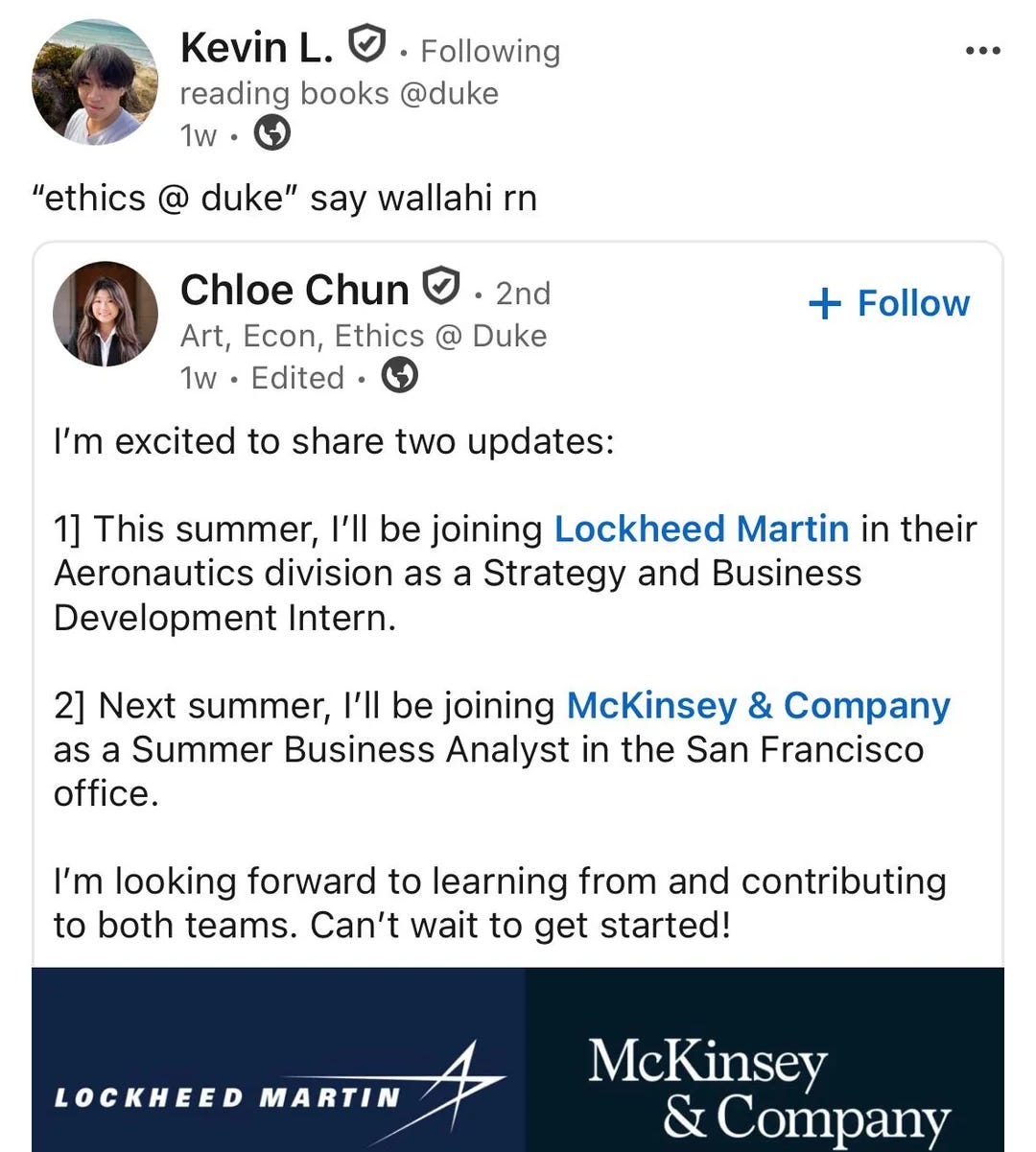
The student’s account bio is “Art, Econ, & Ethics @ Duke.” It’s dystopian how the choice to major in ethics has been flattened to a resume builder to pursue recruiting against the entire major’s teaching. Higher education has been reduced to a tool to maximize your salary ROI, and in a period when college has become more expensive than ever, and the job market is just as stringent, it makes sense that personal branding through majors and a constant professional presence on LinkedIn are required to succeed post-grad. As a recent college graduate, I feel torn on how much to hold it against this student. How much do I accept the reality of finding a job post-grad as a matter of survival, no matter the job, and how much do I hold them accountable? Commenters on Kevin’s post and I have the same question at hand: can you justify accepting a position, even if it’s your only option, if that career path actively compromises the survival of others?
But we seem to selectively judge student performance based on knowledge of an industry’s harms. While we assume that the student recruiting for a marketing agency or biomedical research position is exempt from moral responsibility in a way that the consulting and weapons manufacturing industries aren’t, they both still contribute to the capitalistic machine, despite the varying PR of the industries. Marketing agencies can be seen as a late-stage capitalist agent polluting our visual landscape with the constant selling of unnecessary products, and biomedical research can result in pharmaceutical companies selling your research to make a profit by upselling and restricting life-saving drugs. However, while Lockheed Martin & McKinsey’s negative impacts are direct, legible, and widely known, the harms of a marketing agency or a biomedical research field are more ambiguous. I think we can all agree that we aren’t going to blame the Starbucks barista for Starbucks’ moral failures, but then how can we also agree that the Lockheed Martin intern is morally responsible?
The distinction is entirely in how we perceive systemic hierarchy and agency. A barista is trading survival labor as a victim of the economy, which they have no power to change. An intern at McKinsey or Lockheed, however, is paying a premium to enter the professional-managerial class, using their Ethics majors at prestigious universities to gain extreme power and wealth at the hands of people like Starbucks baristas.
The evolution of the “This you?” into LinkedIn format feels inextricably linked to the rising class consciousness in American politics. As anti-billionaire rhetoric has gained traction and people have become more critical of others’ participation in the system, the reality of how detached corporate achievement is from any moral foundation becomes increasingly obvious. Society is tired of the theater.
Ultimately, the furious internet discourse about Kevin’s post speaks volumes about our modern ethical reality. We don’t care if the McKinsey intern is “just trying to survive” the historically tough post-grad job market like the rest of us, since we know their version of survival includes a six-figure starting salary, a luxury apartment in San Francisco, and a trajectory into the elite class, regardless of how vocally unethical their company is. The judgment surrounding the Duke Ethics student centers more on how she made the transactional nature of elite success an open secret, and by doing so, broke the silent rule of modern careerism. If you’re going to sell out, you’re at least supposed to pretend you feel bad about it.
Just went down this rabbit hole and the craziest part of this is that their recruiting timeline in 2 summers in advance for an intern??? like how???
You’re right, I do feel like our options increasingly are barista or war mongerer or some third also mid-unethical thing in comms. Chloe Chun isn’t the only person faced with these choices, but this 1 example does feel like overzealous engagement with the war machine. But when does someone “just doing their job” because complicit in mass genocide and destruction? Lots to think about here!! Thanks for sharing this Nick.